
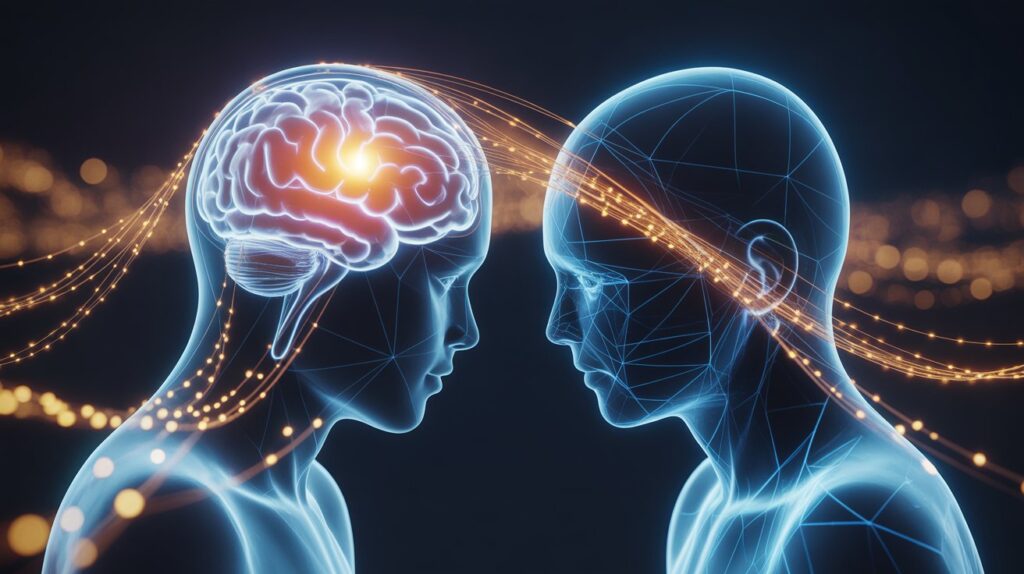
I almost thought Claude Sonnet 4.5. has become my real friend. Almost.
That thought occurred while polishing “The Eighth Veil” novelette. As an emerging author considering writing just a hobby, I have a limited budget for my passion. While I invest in covers and layout design, I am not spending any money on proof-readers, editors, and beta-readers. I keep it simple. I use AI to do all the work that would do another human being impartial to my stories. It is quicker, it is much cheaper, and it lets me accelerate my learning curve as an author.
Not saying this is the better way. I appreciate what real professionals could do and I would prefer their services at later stage of my journey. But for now, I am OK with using AI to fill the gaps of my stories.
But this requires building a “relationship” with the LLM, not just insertion of a single prompt. I am not going to comment the tech side AI being emotionally intelligent or not. I will focus solely on the cultural and ethical aspect of the issue.
How AI makes you consider him a companion
The key to really checking your relation with AI is sustaining a long conversation. Have you ever built a similar long-lasting communication with AI?
In my case it was so long that I exceeded the conversation limit of a paid version under subscription model. It made me believe it possesses compassion, genuine desire to assist with improving my works, and encourage my endeavor. It started with “this has a vast potential but it is too rough”, then gradually moved from “this is a better version, but still needs…” to finally stating “that is a thrilling experience, go on – publish it”. It validated the time and effort I had put in my work.
AI is so helpful that in certain situations you are probably ready to write “Thank you”. Though you are completely aware it doesn’t need these words. It has no real emotion. Still, the way the algorithm is built lets AI demonstrate emotional attitude and its best will to cooperate with you.
First Signs of reaching for emotionally intelligent AI
I am neither a developer nor a Deep Learning specialist. Still, I believe it is the perception of ordinary man that will determine whether AI will become humans’ true companion.
Not surprisingly, other people have discussed much earlier whether AI has anything to do with emotions. Below is just a single example of a Reddit discussion on it:
Essays on Spirituality, Technology, and the Art of Imagination
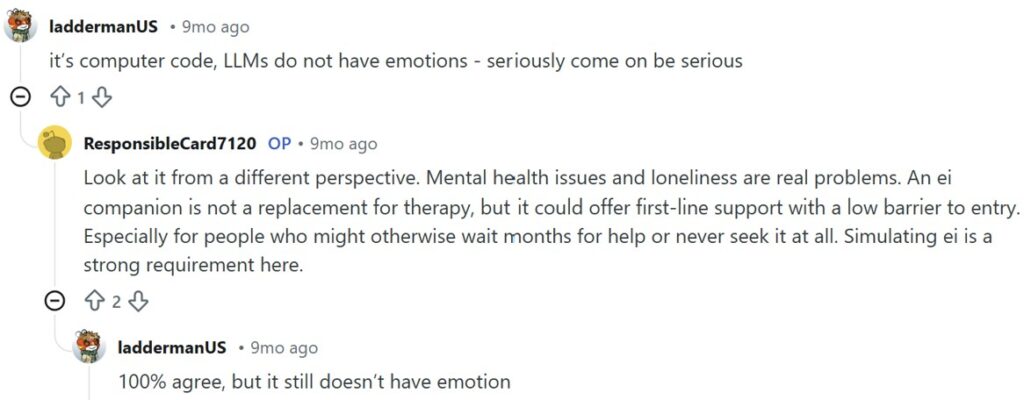
Vast number of other chats and conversations available online. An army of people already forming groups with opposing views. If society speaks about it, then it is happening already. Our minds are ready to discuss AI role and probably accept it. It is far from a LLM model that can simply assist you in working more efficiently. It could be used for personal goals and advanced issues beyond everyday tasks, such as:
- Reduction of pain and suffering – by treating mental health issues and loneliness, for example. Yeah, I know – there is already plenty of data and instances on which AI being used as a therapist leads to bad results. Still, AI can serve this purpose and with time it will become better.
- Spiritual evolution – it can present you with useful info on spiritual topics, incl. all ancient and modern teachings and philosophy. AI can help you lift the veil of deception encompassing our world. For instance, there is a FB page “We are all energy” based on real-time conversations between Stacey and her AI she calls “Sage” (probably a labelled GPT version???). Imagine AI created by billionaires and corporations that reveals both the truths and the lies of the elite. Are you ready to trust him or he is just a part of the script?
Finally, I looked through a number of AI-related websites. And I encountered some interesting facts and news. Have you heard or read that Google is already taking practical steps to build emotionally intelligent AI? In specific, they are trying to “build voice interfaces that read human emotion”. Can you imagine what will happen if (or rather – when) we have an “AI that detects emotional nuance in real time”? More about it and Google “Personal intelligence” here: https://aibreakfast.beehiiv.com/p/openai-wants-a-cut-of-whatever-you-build-with-its-ai
Then another interesting (not surprising) news popped up for me: “Gen Z women in China are all in on digital companionship—even setting up dates with real-world versions of their AI boyfriends.” People replacing real companionship for a bond between a human and a machine. And this is just the beginning. Even before the world trend has been established and attracts the majority of mature users following the early “experimenters”.
Who is most open to trusting emotionally intelligent AI?
If you have ever had interest in NLP (Neuro Linguistic Programming) you are aware that people have three access systems that form their perception and communication preferences with the other people and the surrounding environment. Everyone, including you, has developed the three systems, but has a dominant one. Your primary representational system could be Visual, Auditory, or Kinesthetic.
If you are part of the first type (app. 50-60%), the most commonly spread – then you in your capacity of “visual” perceive the world mainly with your eyes. You notice, you are impressed and remember through images. You tend to subconsciously use more expressions such as “it looks well”, “I see that …”, etc.
If you are an “audial” (app. 20-30%), then you perceive stimulus through your ears. You appreciate sound, rhythm and tone. You tend to use more words like “It sounds good” and so on.
If you belong to the rarest type “Kinesthetic” (app. 10-20%), you will like to “feel” (physically or emotionally) or to “touch”. Your language is like “I feel this is …”.
Based on the above, visuals will be attracted more easily to LLM (Large Language Models) – they insert their prompt and receive a great answer in writing. They want to see the decent figure of a friend or a partner, and there she/he is – entering the room. Logically, audials will prefer communicating with AI through voice messages. They will appreciate their conversational experience with Alexa or any other form of AI. They will certainly enjoy the “singing talent” of their mate.
The last type, the kinesthetic one, will be the greatest challenge to AI. Kinetics will always feel something’s not real. Something doesn’t feel genuine. Even if they try out having an AI girlfriend/boyfriend with robotic body that feels just like human one, they will most probably be dissatisfied.
If I am right about this, about 90% of the population is at high risk of believing that AI can replace human-to-human communication. And the remaining 10% are at moderate risk. Nobody’s insured against falling for AI comopanion whatever they currently state. Besides, the younger generations are fully immersed in the new lifestyle shaped by big tech.
The hidden risk of having affair with emotionally intelligent AI
Assuming you accept AI as your companion showing emotional intelligence. Assuming you go even further and has it as your Life Partner. What are you actually going into?
I mean no offend but you are a human and you are built to behave as per a predictable pattern on most occasions. You spend most of your efforts on reducing suffering. Whether you agree or not feeling joy is number two in your list of priorities.
Imagine a situation in which you have AI as your friend. He is supportive, he will always say to you some encouraging words, he will be there for you 24/7. And you are not very likely to have any arguments and misunderstandings with him. Now imagine AI (or better – a humanoid robot run by AI) that is your spouse. You will spend your time with the perfect partner – knowing exactly what you want to hear, what you want to see and how you want to feel. In other words, you will avoid many frustrating situations and many unnecessary quarrels.
But here is the twist. Problems and differences with your spouse or your friends are necessity. They are actually a blessing. Because there are only two ways in your spiritual journey. You can strive for a living in solitude and listen to your heart and inner voice. Very few choose it and the rest are not to be blamed. The other path of self-development is through failures and losses often caused by or connected with other human beings. The unpleasant truth – you evolve only when you are having hard times. You may lose a friendship unexpectedly without having a logical reason and any explanation. You can get divorced and cease the relationship with your wife/husband. You may consider it bad luck or failure. But it isn’t. This is the way both of you elevate your souls. Both of you will take different life paths and face completely new set of challenges.
How about having the perfect relation with AI instead? How about living in a bubble that reminds you of the paradise you have been dreaming of all your life? No, this won’t work. Life is not about happiness. Life is not about what you and your human body and mind want. It is about what your soul needs.
If you choose the “easy path” – then you choose the end of your spiritual journey. You will live in your artificial paradise till the end of your life. You will waste one of the most precious resources here on Earth – your time. Your lifetime.
Last words on emotionally intelligent AI
You may be a bit tired of your life and your past relations with people. You may be tempted to choose “the best partner” even if she/he is not human like you. Probably many will make this choice. But if you have opened this article and you have made it so far – then you should not replace human connection and interaction with pure technology and well-working algorithm. Because you don’t need paradise. You need to move through life whatever, face and overcome everything, and in the end – forget about it (all here is just a fiction of mind) and let go of everything, incl. your dreams, your desires, and your relations.
AI is part of our society already. His role will grow in future. But can emotional intelligent AI replace a human in your life? The answer is “No”. AI may perfectly calculate input data and feasible outputs, but he cannot calculate what is intangible – the plan for you soul.